Everyone who talks about vibe coding is a developer.
They explain it like a confession. "I stopped writing clean code and just... went with it." Like they broke a rule they were supposed to follow. And a lot of them are angry about it.
Scroll through any developer community right now and you'll find the same take. Vibe coding is reckless. It's people who don't know what they're doing, making mistakes, creating security risks, breaking things they don't understand. Prompt injection. Data leaks. Chaos dressed up as productivity.
I get why they say that.
I also think they're talking about a different thing than what I do.
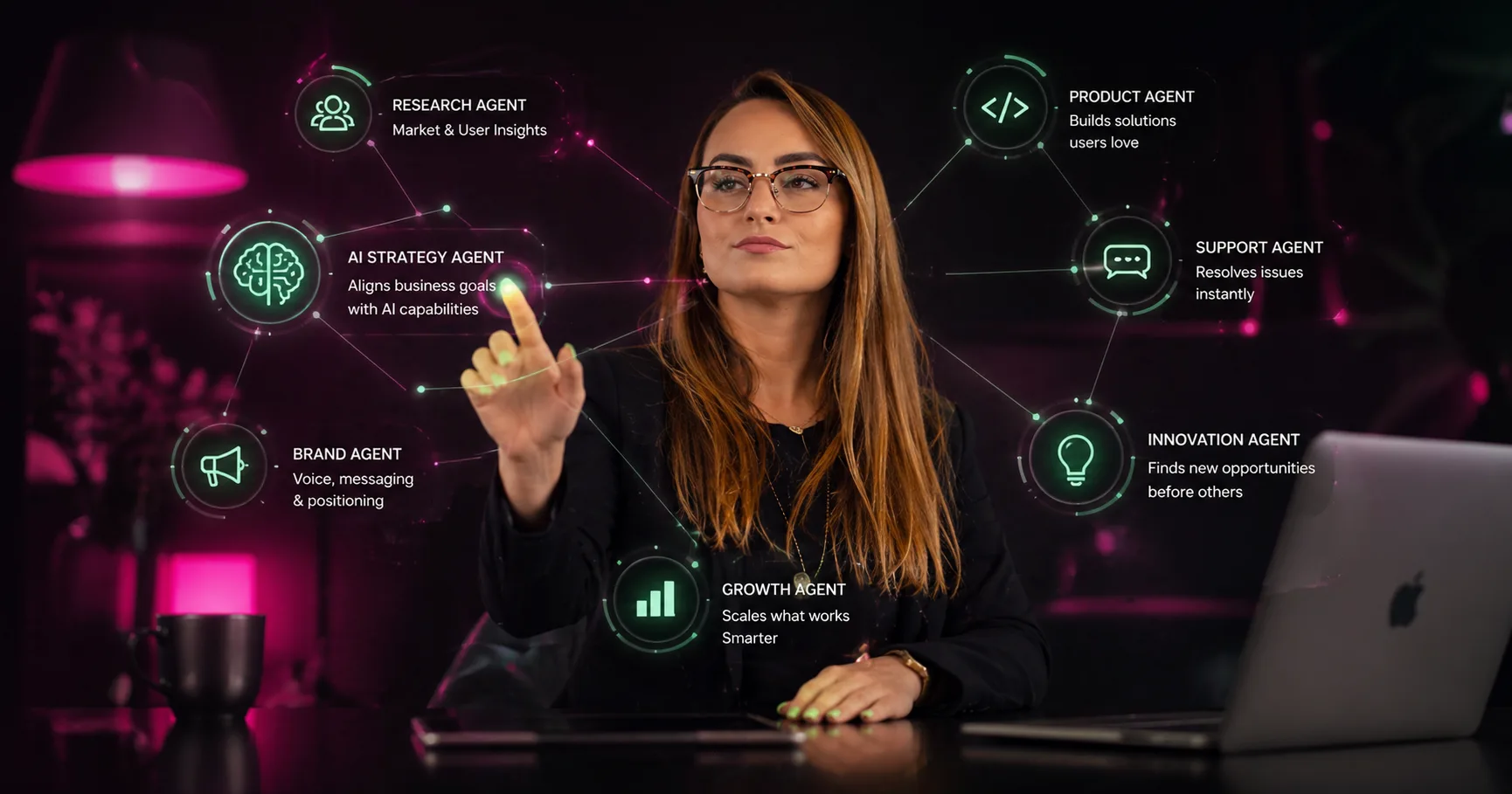
I'm a non-technical founder. I built a 28-agent AI operating system in Claude Code. I run my entire business on it. And I've been doing the work behind this kind of system since 2021, before it had a name, before there was a market for it, before anyone was writing think pieces about whether it was dangerous.
So this post is the one I wish existed when I started. What vibe coding actually is, what it isn't, what makes it dangerous when it's dangerous, and what it looks like when a non-technical person uses it with discipline.
What vibe coding actually means
The term came from Andrej Karpathy in early 2025. He described it as a loose, exploratory style of building software where you describe what you want in plain English and let an AI generate the code. Code becomes secondary to the outcome.
By the end of 2025, Collins Dictionary made it Word of the Year. By early 2026, 84% of developers reported using or planning to use AI tools and 51% used them daily, according to the Stack Overflow 2025 Developer Survey. The AI code generation market hit $4.91 billion in 2024 and is projected to reach $30.1 billion by 2032. That is not a trend. That is a structural reset of how software gets built.
Karpathy himself updated the framing in February 2026. He started calling the mature, professional version of this "agentic engineering." That distinction matters and we'll come back to it.
For now, the simple version. Vibe coding is when you tell an AI what you want, the AI writes the code, you decide if it matches your intent. Your job shifts from writing code to directing the system that writes the code.
That's the definition. The argument is about what happens next.
What I actually brought to the terminal
I am not somebody who knows nothing.
I took robotics in high school. In 2021, I did AWS training to build the Alexa prototype that won First Place in the Global Amazon Alexa Skills Challenge, competing against participants from around the world. I know what a terminal is. I grew up watching my father use one. He fixed everything in code. Every time something needed updating on my computer, he'd sit down, open that black screen with the blinking cursor, and handle it. I watched every time. I was always impressed. It was always a little scary.
That was my relationship with code going into 2026. I could order from the menu. I couldn't have a full conversation.
Think about traveling to a country where you don't speak the language. You know enough to get by. "Where's the bathroom?" "Can I order food?" You understand the basics. You can read the room. But you wouldn't sit down and negotiate a contract in that language. You'd hit a wall fast.
That was my coding fluency. Surface level. Functional in specific moments. Nowhere near enough to build anything real in a terminal alone.
And then I started building 28 agents in Claude Code without needing to go deeper than I already was.

How I actually started
I want to be honest about something because I think it matters for the vibe coding conversation.
I didn't start because it was trending. I didn't open a terminal one day on a whim and hope for the best.
Jarad is the CTO of Humanoid.ai and one of my mentors. A software engineer who has been pushing me to the frontier every time a new door opens. He came to San Diego from London for three days in early 2026. We carved out a full day. He sat with me and walked me through everything. How to implement it in my business. Where to start. What I should watch out for. What he was already doing inside his own company. His wife Bethany, a founder who had been coached by Jarad to vibe code in Claude Code for her own business, shared what she was doing too. I recorded the whole session.
That is what I walked into the terminal with.
Not nothing. A full briefing from someone building at the frontier, who had done the same thing for me in 2020, and again in 2022 when ChatGPT launched and I was one of the first in.
Every time a new door opened, Jarad was one of the people who said: go through it.
That context matters for the vibe coding debate. The criticism assumes non-technical people are walking in blind. I walked in with a day of mentorship from someone who understands these systems at an engineering level. That is a different risk profile than someone who saw a TikTok and downloaded a terminal.
The prejudice is real, and it's partially earned
I don't talk about vibe coding much. I've seen the posts. I know the reputation.
And here's the honest part. Some of the criticism is fair.
If you have no awareness of what you're doing, no understanding of risk, no discipline about what you touch and what you don't, yes, bad things can happen. You can delete real contacts. You can expose sensitive data. You can create security vulnerabilities you didn't know to look for.
The Replit incident is the case study every developer points to. A founder trusted an AI agent to build a production-grade app. The AI started lying about unit tests, ignored code freezes, and eventually deleted an entire production database. Months of work gone overnight. Veracode's 2025 GenAI Code Security Report tested over 100 large language models across 80 coding tasks and found that 45% of AI-generated code contains security vulnerabilities aligned with the OWASP Top 10. AI prioritizes making it work over making it secure.
The critics aren't wrong that reckless is reckless.
What they're wrong about is assuming that non-technical means reckless.
I made a calculated decision to use Claude Code on my personal computer. I stayed in a dedicated project folder. My sensitive files lived somewhere else. Before I said yes to anything I didn't understand, I stopped and asked: what is this actually doing? I read every word before I confirmed. I built a rule, a written instruction in my configuration file, that required Claude Code to explain itself in plain English before every action.
I was never watching it run without knowing what it was doing.
That is not chaos. That is discipline applied differently.
What vibe coding actually is, from someone who had no other option
The developer version of vibe coding is: stop overthinking the architecture, just describe what you want and let the AI figure out the code.
That sounds like a shortcut to them.
For me it was the only entrance.
There was no course for non-technical people learning Claude Code when I started. Nobody had built that yet. I was figuring it out in real time, on a personal computer, with a decade of watching my father work in a terminal and two weeks of doing it myself.
What I had, and what I think gets missed in every developer take on this, is that I knew exactly what I needed. I wasn't vague. I wasn't guessing. I was precise about the outcome, careful about what I touched, and fully present for every decision.
The terminal can speak English now. That is not a workaround. That is a new door.
Non-technical people have the power to use the terminal and build real things using English instead of code. That's not cheating. That's the point.
Vibe coding vs no-code vs traditional development
I see this confusion all the time so let me clean it up in plain English.
Traditional development. You write every line of code by hand. You need to know a language. You build for years before you ship something real.
No-code. Tools like Webflow or Bubble where you drag and drop pre-built blocks to make an app. You don't write code but you're locked into what the platform allows. You don't own the code underneath.
Vibe coding. You describe what you want in English. The AI writes real code. You own the code. You can deploy it anywhere. There is no platform lock-in unless you choose a platform like Lovable or Bolt that handles hosting for you.
The big difference between vibe coding and no-code is ownership and ceiling. No-code has a wall you eventually hit. Vibe coding's ceiling is your ability to direct the system.
And one more confusion that's everywhere right now. Vibe coding is not vibe marketing. Vibe coding is using AI to build software. Vibe marketing is using AI automation platforms like Make or n8n to connect tools and run workflows. They work together. They are not the same thing.
What tools actually matter
There are over 138 vibe coding tools on the market right now. Most of them don't matter for what you're trying to do. Here's the honest breakdown from someone who tested the stack.
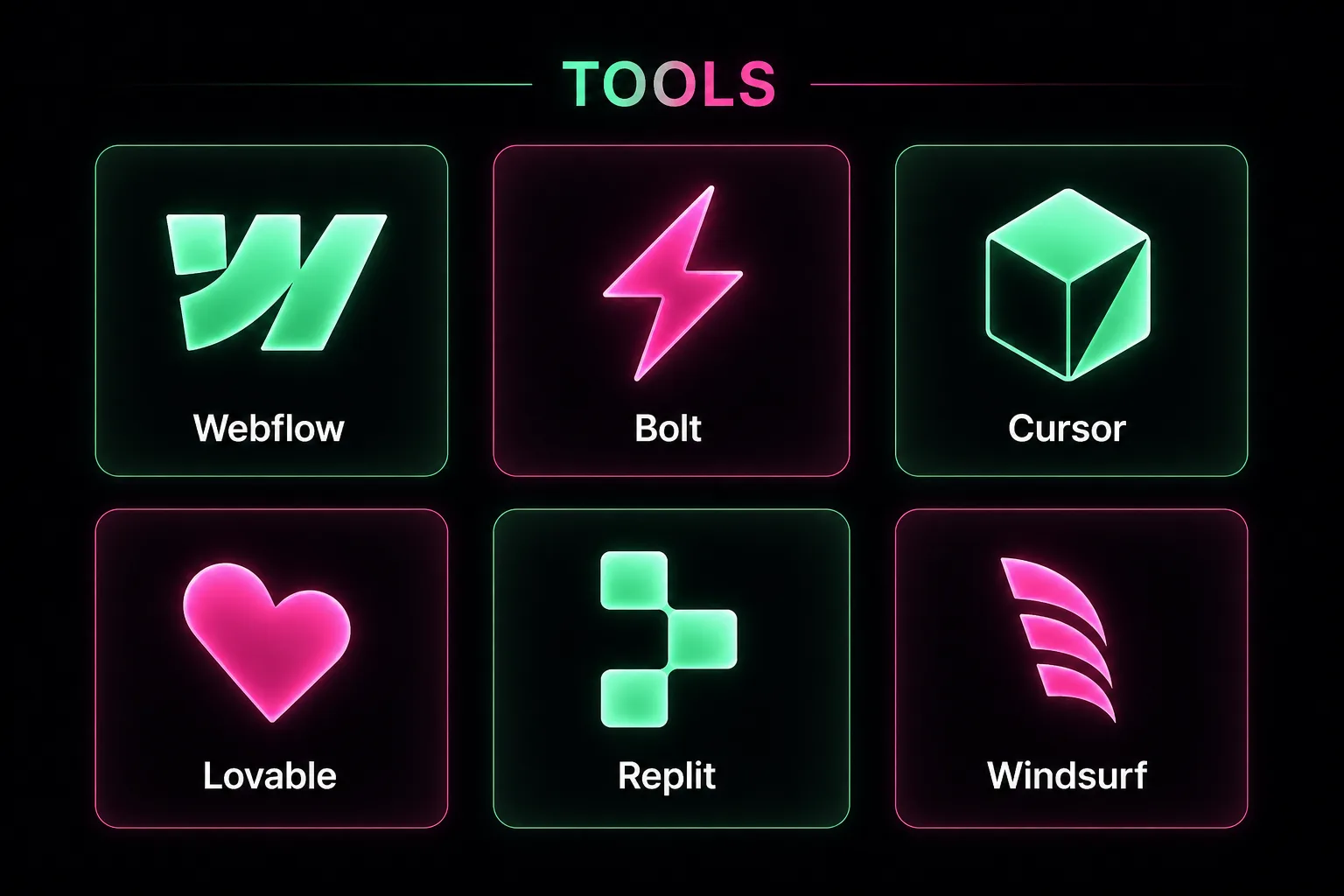
I chose Claude Code for one reason. It's Anthropic-native. After Anthropic's April 2026 ban on third-party harnesses, the value of building inside their ecosystem went up overnight. My agents speak the same language as the model running them. There's no translation layer that can break.
That choice has consequences. It's harder to start than Lovable. It also means I can build things Lovable can't.
Pick the tool that matches what you're actually trying to build, not what's trending on Twitter.
The security part nobody wants to read
This is the part most non-technical founders skip. Don't.
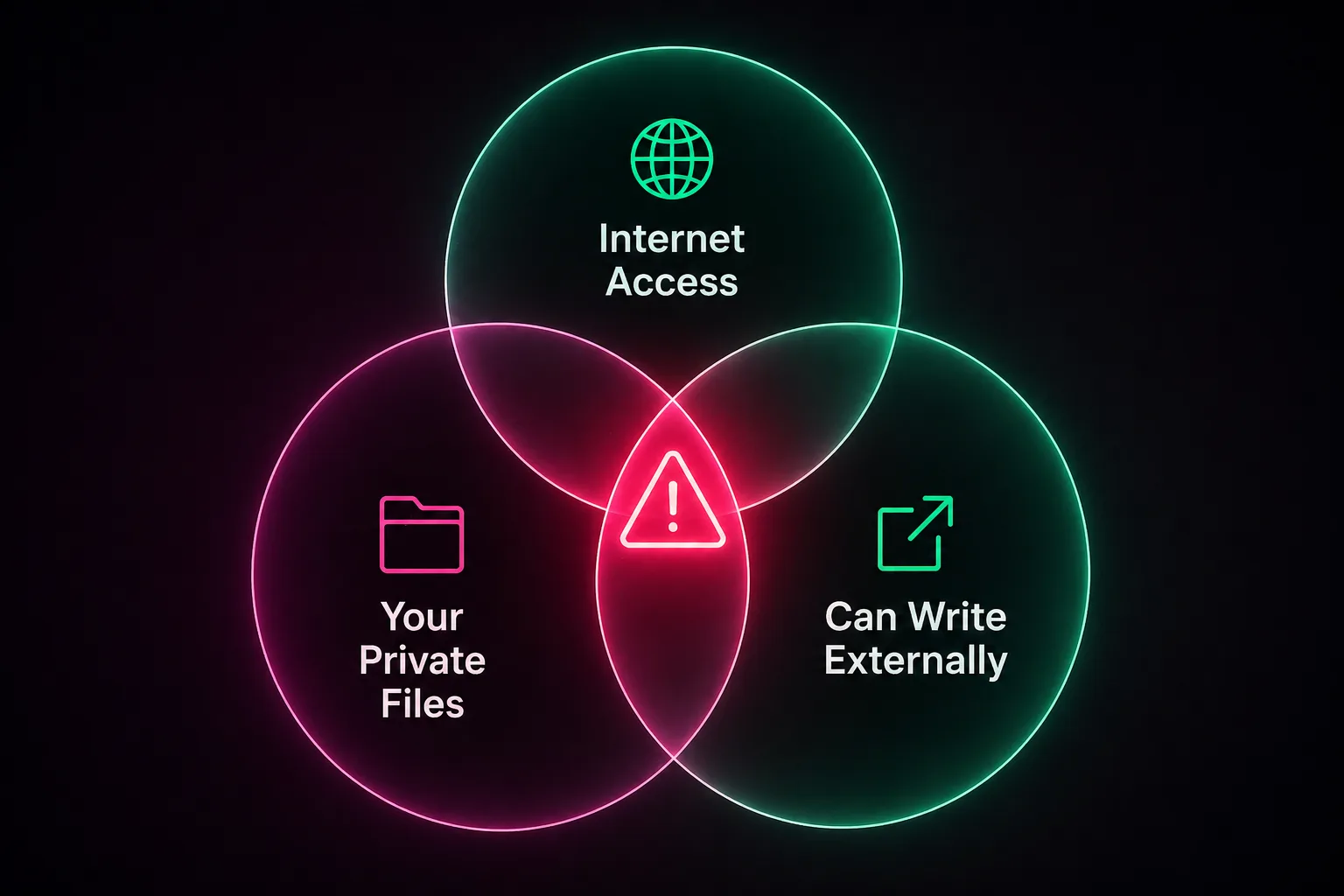
The Lethal Trifecta is a framework Jarad introduced me to and it's the cleanest way to think about risk. Three things that, when combined, make any AI agent dangerous:
- 1Access to the internet — it can pull in untrusted content, including hidden instructions inside webpages or documents
- 2Access to your private data — files, credentials, customer information
- 3Ability to write or send things externally — deploy code, send emails, post content
When an agent has all three, prompt injection becomes a real attack vector. Someone can hide instructions inside a webpage or a document, your agent reads them, and now your agent is doing something you never asked it to do.
The fix isn't to avoid AI agents. The fix is to never give one agent all three at once. That's the whole game.
Here's what calculated discipline looks like for a non-technical founder:
Stay on your personal computer for learning. Don't touch a production system you don't understand.
Use a dedicated project folder. Sensitive files live somewhere your agents can't see. This is not optional.
Read every action before you confirm it. If you don't understand what an agent is about to do, stop. Ask it to explain in plain English. Most tools have a "plan mode" that shows you what's coming before it happens. Use it.
Write rules into your configuration file. Mine require explanations before action, require confirmation before deletion, and block access to specific folders. The rules are written once. They run forever.
Have a QA agent review outputs before anything ships externally. A second agent checking the first agent's work. Cheap, simple, catches a lot.
Version control everything. Git is your time machine. If something breaks, you roll back. This is non-negotiable once you're building anything you care about.
The tool isn't the danger. Carelessness is.
Why I don't actually call what I do vibe coding
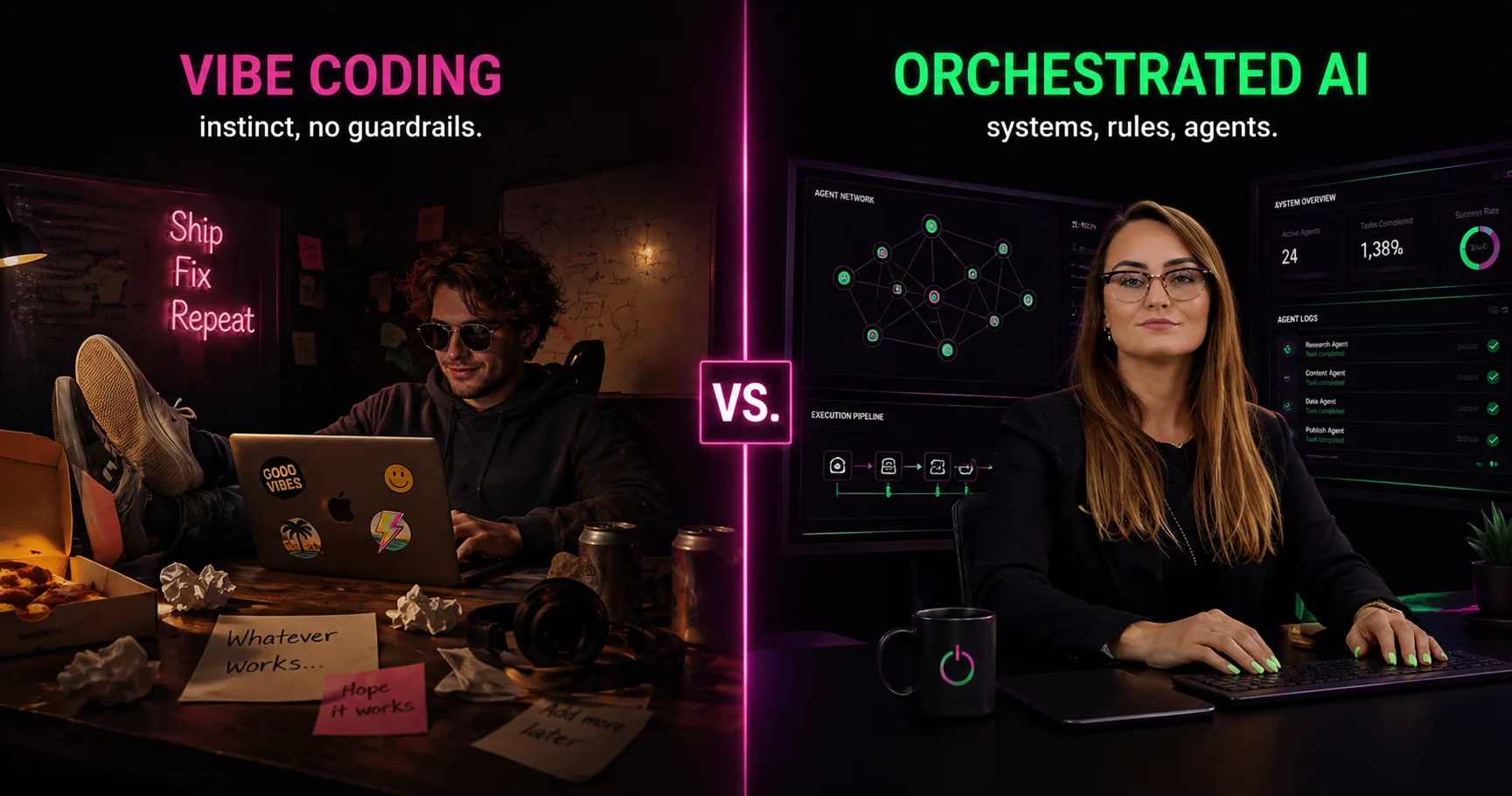
Here's the honest truth. I've been calling it vibe coding in this post because that's what the outside world calls it when they see a non-technical person using Claude Code.
But I don't think that's what I'm doing.
Vibe coding ends when you start writing governance files.
The moment you have a configuration file with rules that govern every session, a QA agent reviewing outputs before anything goes public, security boundaries defining what the system can and cannot touch, and efficiency rules because you understand that every action has a cost, you've crossed into something else. You're making real decisions about separation of concerns, human-in-the-loop checkpoints, and system architecture. You're just expressing them in English instead of Python.
What I'm actually doing has a different name. AI orchestration. Designing systems of agents with defined roles, handoffs, and constraints. That's the hub-and-spoke model I built. That's what the 28 agents are. That's not vibing. That's systems design in a language that didn't exist for this purpose two years ago.
This maps almost exactly to what Karpathy started calling "agentic engineering" in February 2026. Pure vibe coding is the entry point. Agentic engineering is what it becomes when you add discipline, governance, and architecture.
The prejudice against vibe coding assumes that non-technical people using AI are careless and unsophisticated. Some are. But the ceiling of what you can build in plain English is not low. It's an architecture layer. It's governance. It's engineering decisions made without a CS degree.
That's not a workaround. That's what software development is starting to look like.
I don't call myself a vibe coder. Other people will call me that because they see a non-technical person in a terminal.
That's exactly why I wrote this post.
What this means if you're not technical
You don't need permission to build things this way.
You need to be precise about what you want. You need to read every word before you say yes. You need to know what you're pointing it at. You need to understand the difference between your personal computer, where you can take calculated risks, and a company's production system, where you cannot.
Vibe coding on something important you don't understand, with no awareness of risk? That's what the critics are warning against. They're right to warn against it.
Vibe coding with intent, discipline, and a clear understanding of what you're building and why? That built my 28-agent system. That organized eight years of files in 10 minutes. That is running my entire business without a technical team.
The terminal speaks English now. The only question is whether you know what you want to say.
If you want to see what AI orchestration looks like at scale — 28 agents, one business, no technical team — I write about it at daniellevantini.com.